






Velux sounds alarm about daylighting

‘New energy legislation risks unhealthy new buildings’
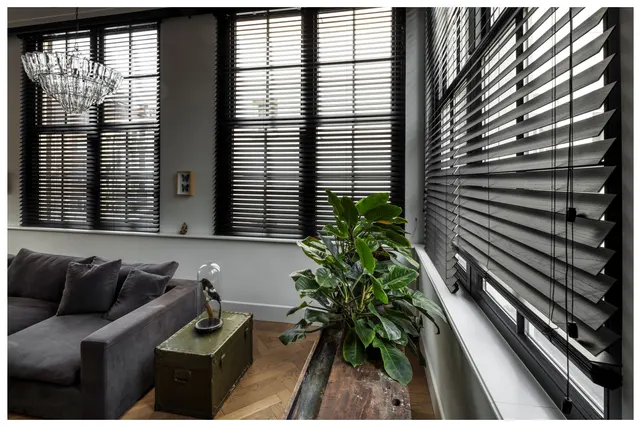
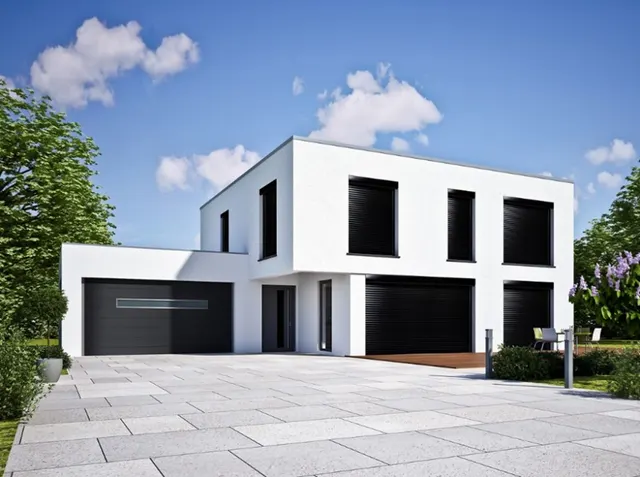
Criticism has been voiced from various quarters regarding certain aspects of the plans to make our built environment more sustainable. One of the objections is that it could compromise the amount of daylight entering homes. One of the critics is VELUX, which profiles itself as a specialist in daylight systems. However, the sun protection industry should also get involved in this discussion. The positive aspects of daylight should not be underestimated, and sun protection or roller shutters can ensure that sufficient light is allowed in, while heat – or possibly cold – is kept out.
The current government's commitment to making the built environment more sustainable could result in homes that are unhealthy and unpleasant to live in if no balance is struck between energy performance and requirements that promote the health of building occupants. The requirements that are supposed to guarantee the health quality for people in buildings are at the absolute minimum, according to VELUX Netherlands in a position paper presented to members of the House of Representatives in early July.
In 2021, the Environment Act will come into force, renewing all regulations concerning the built environment. Six months earlier, the new BENG standards for Nearly Energy-Neutral Buildings will come into effect.
In formulating the Environment Act (Decree on Buildings and the Living Environment), politicians seem to be suffering from tunnel vision and allowing themselves to be overly influenced by the energy issue. “The current daylight standards show no ambition whatsoever to provide homes with sufficient daylight,” says Marcel Vreeken, Public Affairs Manager at VELUX Netherlands. “Politicians have chosen to focus on sustainability and the requirements of the energy transition, with the livability of buildings appearing to be a lower priority.” In the cabinet's current proposal, the daylight standard remains half a square meter per living space. According to Vreeken, this standard will prove inadequate in the future: “There is a risk of a situation arising in which we judge homes on just one aspect – energy savings – while forgetting that buildings should also simply provide comfortable shelter. The Energy Performance Building Directive (EPBD III), published in July 2018, describes the importance of a healthy indoor climate in energy-efficient new buildings. In addition, a completely new European method for determining daylight (NEN EN 17037) has been published, which can be used to calculate the quality of daylight. This standard may be designated in 2021 and is a natural moment to lay down qualitative requirements for the application of daylight in regulations. This will prevent daylight provision from becoming the victim of the need to meet energy performance requirements.”
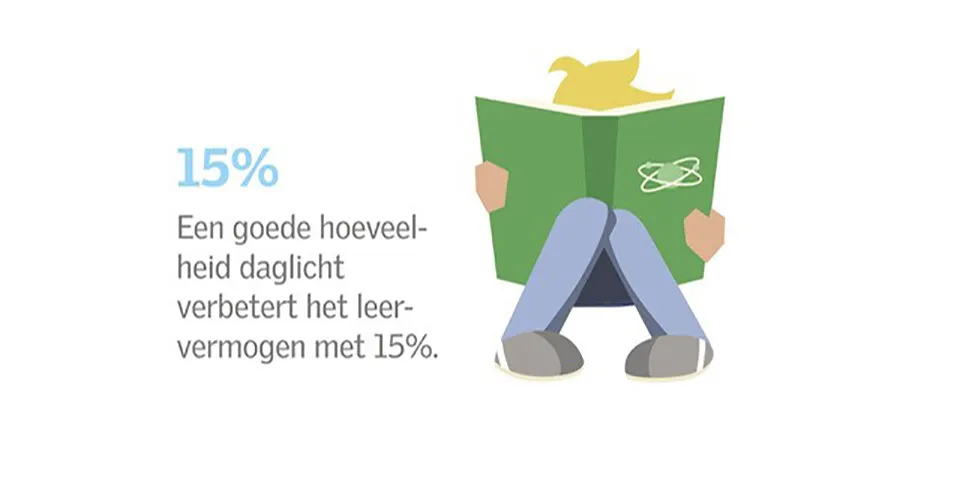
Daylight promotes performance.
Daylight important for health
Daylight is important for people's physical and mental health. In its position paper, VELUX Netherlands cites scientific research showing that daylight plays a positive role in areas such as work productivity, school performance, recovery from illness, and people's mental health.
- Natural light and health – Natural light is essential for human health. It ensures that our biological clock is properly adjusted. Daylight also increases alertness and productivity. Rooms with a lack of natural light can lead to increased fatigue, stress, cardiovascular disease, and a worse mood. A vitamin D deficiency due to insufficient sunlight can lead to increased susceptibility to disease.
In addition, natural light is important for human health for many other reasons. For example, it helps prevent respiratory diseases such as asthma and reduces the effects of Seasonal Affective Disorder, better known as winter depression. Patients in hospitals have a more comfortable stay when there is sufficient daylight and are allowed to go home sooner than patients in hospitals that are relatively dark.
- Productivity – Better daylight access leads to an increase in labor productivity of up to 15%. In addition, more sunlight increases employee satisfaction. Daylight also benefits the learning performance of schoolchildren and students: students in well-lit classrooms score 7% to 18% higher on standardized tests than students in poorly lit classrooms. Incidentally, it is not only daylight, but also views of nature that benefit employee productivity and student learning performance.
Furthermore, according to the 2018 Healthy Homes Barometer, a lack of daylight is one of the four main causes of an unhealthy living environment. Among other things, the development of mold and the associated allergies and illnesses play a role in this. “Dutch law currently only stipulates half a square meter of daylight-illuminated surface area per living space,” notes Vreeken. “That amounts to between 58 and 144 lux of natural light. Scientific literature widely recognizes that people need a minimum light level of 300 lux—illumination level—to perform visual tasks.”
Minimal interpretation
When formulating the regulations, Dutch legislators had to take European directives into account. In its most recent recommendation, the European Commission calls on member states to take the health and comfort of homes into account in their legislation. According to the Commission, this also includes ‘natural light’. “The Netherlands has always been rightly proud of the quality of its homes,” Vreeken responds. “Unfortunately, the Netherlands has now chosen to interpret this European daylight recommendation as minimally as possible, which means that it is possible to build homes in which the comfort of living in our homes may decline.” Vreeken fears that this will cause the Netherlands to fall behind other EU member states.
Energy Performance Building Directive (EPBD) and windows
On July 9, 2018, the new Energy Performance Building Directive (EPBD) came into effect. For all new construction, both residential and non-residential, permit applications must comply with the requirements for nearly energy-neutral buildings (BENG) as of July 1, 2020. These requirements stem from the Energy Agreement for Sustainable Growth and the European EPBD directive.
Within the EPBD, windows are considered a weak factor in the thermal envelope of a building. Many people believe this to be unjustified for several reasons:
- Windows let daylight in and thus contribute to contributes to lower energy consumption for lighting throughout the year.
• By letting the sun's heat in during winter By letting in light, windows contribute to lower energy consumption for heating in winter.
• In summer, windows can be opened to let in the summer air.Let in the cool night air and thus reduce the need for air conditioning.
• Sun protection for windows contributes to preventing overheating. This reduces the cooling requirement. - for example, through the use of air conditioning.
Accountability – This article is based on an article and position paper by VELUX Netherlands on the importance of daylight entry, published in July of this year. All of this can be found at pers.velux.nl.
Question about this story? Ask your question
Keep following this
Get an email when a new story is published. No account needed.
- ThemeLight and privacy indoors
- SubjectGeneral