zenronline.eu
EN
Platform on sun and daylight control, shutters, patio covers and closures

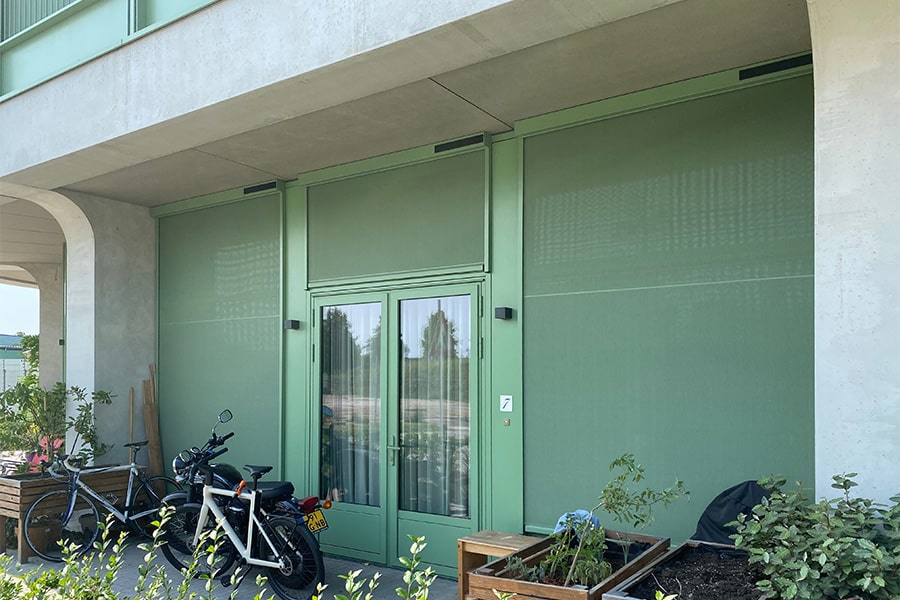
In the new Cartesius neighborhood in Utrecht stands a building that sums up the neighborhood's ambition: healthy, sustainable and social. Designed by Zecc Architects, the Cartesius Solo residential complex consists of 140 apartments, intended for residents working in the cultural and art sectors. The details, from the choice of materials to the blinds with Soltis 86 cloths by Serge Ferrari, underline the sustainable approach of this project.
Screens powered by a solar-powered motor were chosen for the complex's exterior blinds. A total of more than 400 screens were installed, manufactured by Guillaume Janssen and installed by De Kroon Zonwering. “The client wanted the solar shading to be in line with the green concept of the building,” says a spokesperson for De Kroon Zonwering. “With the solar motors, we were able to achieve that perfectly. Each unit works autonomously and is still reliable.”

At the heart of the system is Serge Ferrari's Soltis 86 fabric in Moss Green. Marcos Santos, Key Account Manager Solar Protection Benelux at Serge Ferrari, explains that this technical fabric combines aesthetics and performance. “Thanks to the open structure, the view to the outside is maintained and sufficient daylight penetrates, while up to 75 percent of solar heat is blocked. This keeps it pleasantly cool inside, even on hot summer days.”
This fabric was also chosen because its green hue blends seamlessly with the façade colors and plantings surrounding the complex. “In addition, our patented Précontraint® technology ensures long-term dimensional stability and resistance to deformation. This is an important advantage in large projects with uniform façade surfaces, such as this one.”
The construction of Cartesius Solo had a tight schedule: the sun blinds had to be fully operational before the summer. This required good cooperation between the various parties: on-time delivery by Serge Ferrari, streamlined production by Guillaume Janssen and precise assembly by De Kroon Zonwering.
The result is an installation that not only meets the technical requirements, but also enhances the architectural appearance of the building. The screens add rhythm to the facade and emphasize the balance between transparency and shelter.
Cartesius Solo shows how shading can play an active role in sustainable construction. “Solar shading is increasingly not just seen as functional,” says Santos. “In this project, solar shading is really an integral part of the architectural and ecological concept. The integration of Soltis 86 provides thermal comfort and UV protection to residents, but also reflects the district's commitment to a greener and healthier lifestyle.”
Neem dan rechtstreeks contact op met Guillaume Janssen.
 Contact opnemen
Guillaume Janssen B.V. project supplier of Special awnings The ideal project supplier and partner in the market segment of (special) projects. If your standard supplier is not sufficient, we are happy to help you find the right solution for your situation. You can think of very narrow, wide or high ZIP systems with special specifications. In addition, we offer [...]
Bekijk Bedrijfsprofiel