






HOW DOES THE MODERN AWNING MANUFACTURER WORK?
MARKILUX USES MODERN METHODS AND TECHNIQUES
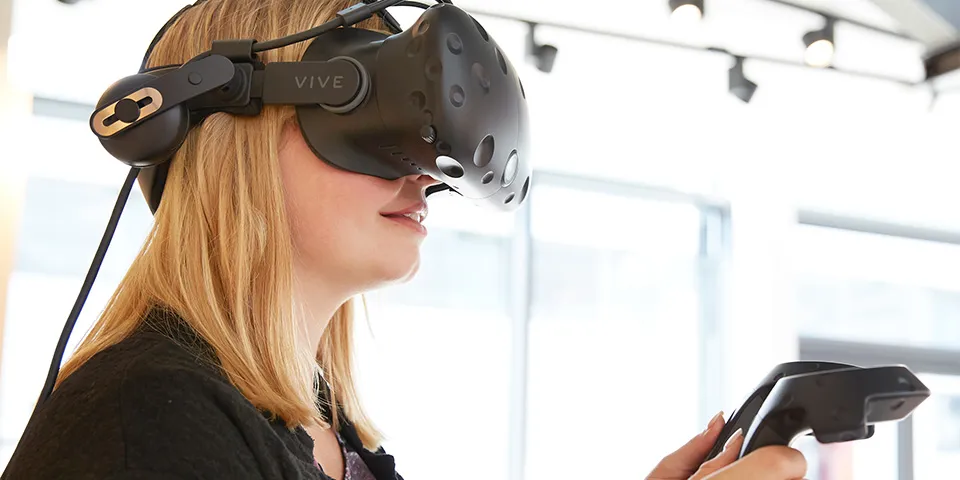
There are many ways an awning manufacturer can function. It doesn't all have to be high-tech. Markilux is one company that does choose to use state-of-the-art technology. One manifestation of this is the use of virtual reality glasses in the production of new awnings.
Virtual reality glasses have been very popular in the entertainment industry for years, but industry has also recognized their potential. They can be used to check early on whether prototypes of new products and components are suitable for further development. Awning specialist markilux also uses VR glasses to create a virtual reality.
Michael Gerling appreciates the use. “We chose these glasses because parts and designs of new models can be displayed very realistically. This allows a quick assessment of how a construction or design works and whether it functions. Also, entire landscapes or buildings can be displayed virtually to properly visualize how a new screen combines with a home.”
Faster decision-making through VR technology
Virtual reality technology also allows for quicker decisions to be made for or against initial ideas of a new product. Using the design software, data can be sent directly to the VR glasses and verified. “For example, we had several designs of our new cassette screen MX-3 up for discussion in our development group,” Gerling said. “The models could be viewed with the VR glasses. This is much more vivid than a presentation and produces faster results. This reduces development time, also because markilux has been using 3D printing for prototyping for years. Real three-dimensional objects and virtual 3D models complement each other perfectly in the construction process.”
Using VR frequently
Meanwhile, virtual reality at markilux plays a role not only in construction, but also in sales. VR technology is used at road shows, for example, to demonstrate products that cannot be presented on site. “In this way, customers can see our screens in an environment that approximates reality as closely as possible,” Gerling said. “This leads to better sales opportunities, especially if consumers can also view their personal product selection with VR glasses.” In addition, he said, it is conceivable that VR glasses could also be used in the future when training employees and dealers or planning production, in order to get an accurate spatial image in advance. “We are open to the use of VR technology, which we want to use as widely as possible, to facilitate or speed up labor processes or support sales.”
Question about this story? Ask your question
Keep following this
Get an email when a new story is published. No account needed.
- ThemeDoing business in the solar shading industry
- SubjectGeneral