





From idea to series production
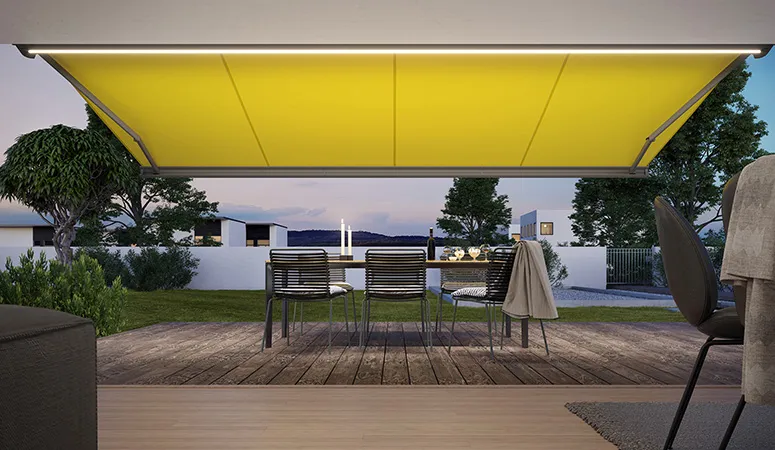
markilux products are meticulously planned. This also applies to the MX-3 cassette awning, which took over two years to develop.
Ideas for new products do not usually come out of thin air, and it is rare for a new product to follow a vision in its purest form. It is usually a lengthy process of careful observation and analysis, from which something new emerges. At least, that is how markilux describes the path their products take before they reach the market. This also applies to the new MX-3 from the sun protection specialist. The decisive factor in this process is always to think the product idea through from the customer's perspective.
The MX-3 is the latest model from markilux. The cassette awning was launched at the beginning of the year. With this, the company is further expanding its range of designer awnings. However, according to markilux, each model is preceded by a long process of analysis before development begins. “We worked on the MX-3 for almost two years, from the initial idea to series production,” says Michael Gerling, Director of Production and Technical Development. The actual start of such a process goes back even further. It begins with observing the market and identifying customer needs. According to Michael Gerling, all products are designed from their perspective. “Suitable ideas end up in our development cycle. Every month, we compare them with market demand. As soon as there is a common ground, you have to see if your own know-how can produce the best, fastest, most innovative, and unique product idea,“ adds Mr. Gerling. “Then we go into detail, determining market prices, quantities, and tooling costs. Only when the idea, demand, unique position, and costs form a complete picture do we give the go-ahead and our designers can get to work.”
For Michael Gerling, Director of Production and Technical Development at markilux, it is always exciting to bring a new product into series production. For the MX-3 cassette awning, which has been on the market since the beginning of the year, the entire process from idea to finished product took around two years.

MX-3, a screen with new color options
With the MX-3, the company first asked itself what a new screen would need to offer in order to be a sales success. The developers quickly agreed that the triad of technology, form, and sun protection fabric needed a special touch. Something that had never been seen before. In addition, the new model had to be highly customizable. “To this end, our designers and specialists searched for trends at trade fairs and on trips and collected suggestions for awnings and awning fabrics,” says Michael Gerling. This pool of inspiration ultimately gave rise to a concrete idea, which several departments worked on. The aim was to create a cassette screen with a timeless design that revealed little of the technology behind it. A screen that would attract attention with its shape and, in particular, its color.
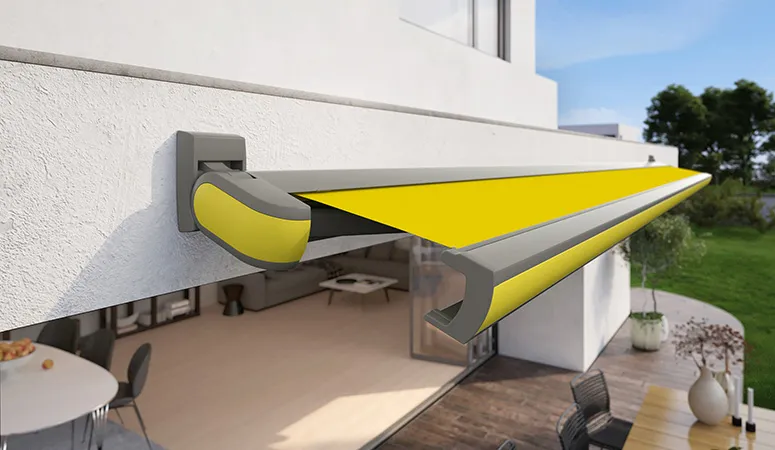
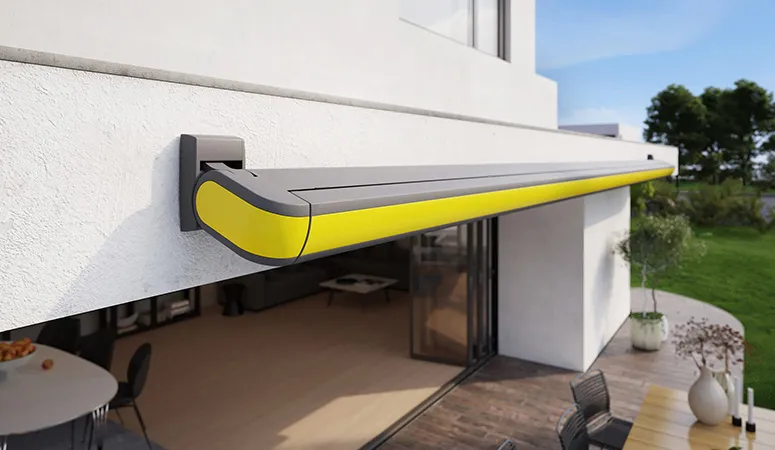
The curved front panel is a novelty.
According to Gerling, defining oneself through color is a powerful trend. He varies between discreet and striking colors. “This fits perfectly with the style elements of our group's portfolio,” says Mr. Gerling, explaining: “On the one hand, we offer simple lounge colors for the screens, combined with structured, timeless plain fabrics. On the other hand, however, there is also a palette of colorful screen fabrics, coupled with the option of strongly emphasizing the screen frame with colorful elements.” This is exactly what was used to give the new MX-3 its unique look. In the form of a colorful front panel, which flows smoothly around the cassette with soft curves on the side caps. This design element, which is available in eight colors, sets it apart from other products. In this way, it was new and, moreover, challenging in its filigree design.
A good 40 steps to the new product
The shape of the MX-3 had to be timeless, with an elegant silhouette, generous width, and smartly clad support consoles. In addition to the colored bezel, the model also had to be fitted with a new lighting element. In the form of an LED line or, optionally, LED spotlights under the cassette. “When it came to the look and technology, we again felt it was important to focus on design and comfort. But on condition that this was linked to an attractive market value. Because good design and good quality should not be reserved for the upper price segment,” says Mr. Gerling. In order to visualize such ideas for new products and to clarify dimensions and proportions, markilux has been using 3D printing for several years. This speeds up the construction phase. Once the shape, dimensions, and design have been finalized, prototypes are produced, accompanied by numerous corrective steps in the fine construction process and tests in the company's own test laboratory. “With the MX-3, there were around 40 process steps before series production. “It's always a long road to develop a product, and it's always exciting to see the results at a certain point. A well-coordinated team works on this for a long time. When something like the new MX-3 rolls out, the effort has been worthwhile for us,” Michael Gerling notes happily.
Question about this story? Ask your question
Keep following this
Get an email when a new story is published. No account needed.
- ThemeSolar shading against heat and energy loss
- SubjectGeneral