






EVERYTHING YOU ALREADY KNOW ABOUT SCREEN BLINDS
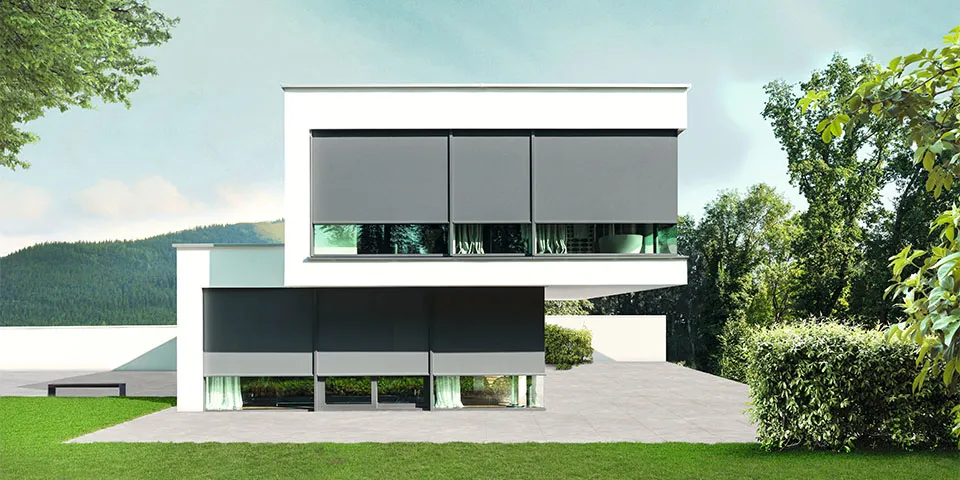
You are a reader of Z&R, so you are either a manufacturer, a supplier or an awning dealer. You already know everything there is to know about screens! You could continue reading, because everything in this article is easy for you. Or would you like the facts again?
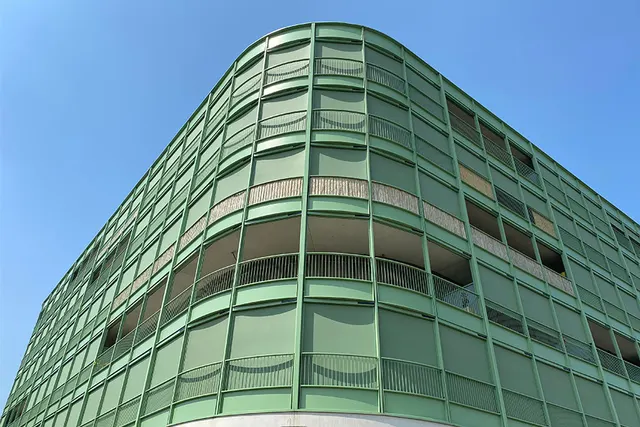
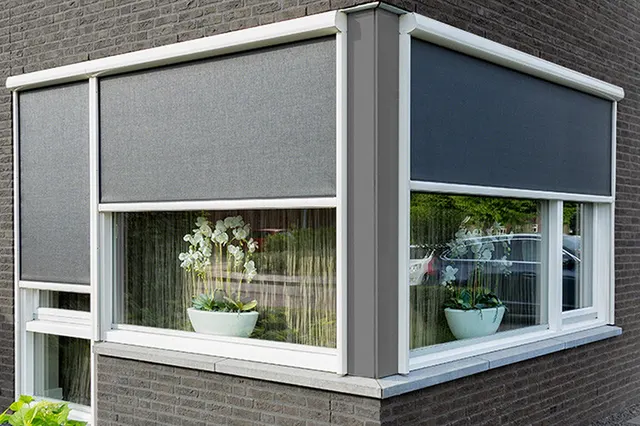
A screen is a vertical awning that opens and closes in the façade plane. Because of the vertical position, screens also protect well against low sun. This is especially useful for east- or west-facing windows, indeed because of the rising and setting sun. The opening factor of the fabric does play a role: if the sun is directly on it, it can more easily "penetrate" the fabric. Because a screen is mounted practically against the window, it also blocks sunlight from the side. The amount of solar heat and radiation that can penetrate can be substantially reduced with screens, depending in part on the type of fabric chosen.
Screen challengers
A screen is one option to block out the sun. These are the main challengers:
Roller Shutter - Keeps sun and heat out, but does not offer see-through.
Outdoor blind - Keeps the heat out. Also repels low-level sun.
Drop screen - Wind resistance depending on drop arm system. Preservation of view through to the outside.
Articulated awning - Especially a patio awning. Preserving see-through to the outside.
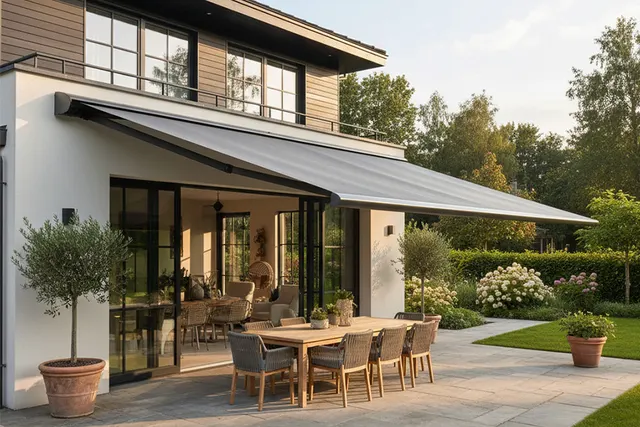
Marquis - Wind-resistant, while maintaining see-through to the outside. Also blocks (sun) light entering from the side.
What are important considerations when buying screens? An overview.
Fabric Type
Two types of cloth are used for screens. The most stable cloths consist of woven fiberglass with a PVC coating. They can handle large sizes up to six meters and are available in many colors and with different opening factors.
The second fabric type consists of polyester fiber with a PVC coating. This cloth is available in more opening factors but slightly more limited in dimensions. It is also available in many colors.
Transparency and view
The opening factor of screen fabric can range from 1 to 15%, meaning that 1 to 15% of daylight, heat and energy passes through it. In the Netherlands and Belgium, opening factor of around 5% is usually chosen.
See-through goes from dark to light: during the day: from inside to outside, if it is dark outside and light inside vice versa. If desired, this can be anticipated with a fabric with a low openness of 1 or even 0%. The latter fabric can have a gray coating on the inside, making it completely darkening.
Color of cloth
The color of the cloth is, of course, first and foremost a matter of personal taste. But the color also affects the properties of the fabric: lighter colors reflect better, darker fabrics provide better visibility. Experts believe that black is the best color of cloth because it allows the least amount of sunlight to fall on the glass and therefore best blocks heat.
Color of hardware
While we're on the subject of color, let's not forget the color of the hardware, such as the case, guides and bottom bar. A screen is placed in or on the day, near or on the window frame. Logically, the color of the window frame is usually chosen.
Guidance system
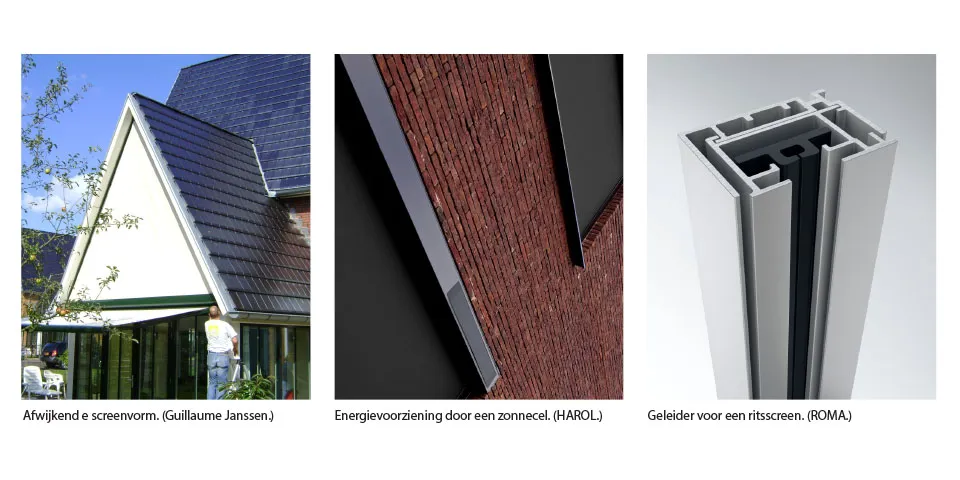
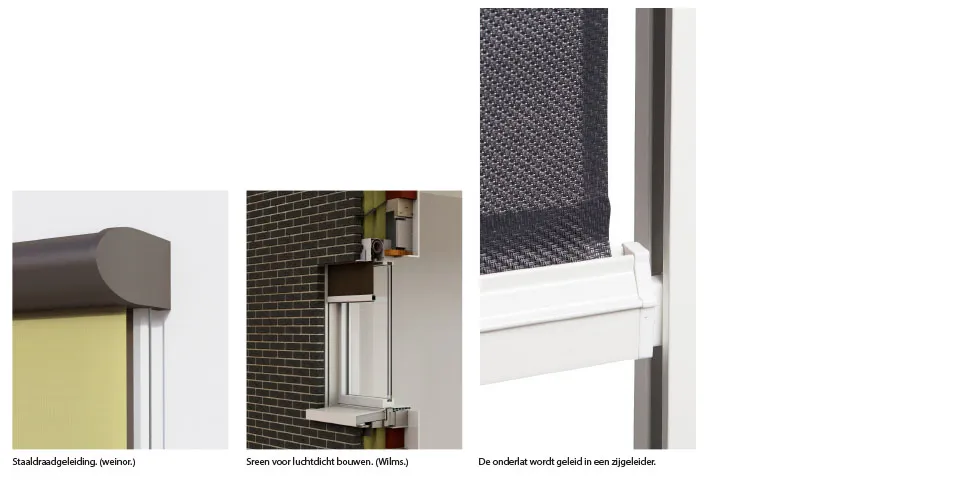
Screens can be with or without side guides. Without means that only the bottom rail is guided in a guide or by a steel wire. The fabric is otherwise loose and there is a light/air gap between the fabric and the guide. Nowadays, zipper screens are increasingly used. The fabric is then fixed in the side guides by means of a zipper. Advantages: no light gaps and more wind resistant (no torn fabric). Some manufacturers also claim that their zipper screens are insect repellent.
Operation
Screens without a zipper can possibly be operated by hand, but opening a zipper screen requires some force, in which case motor drive is a better idea. Screens with a motor can be controlled in several ways: with a switch on the wall, a remote control or with an app on smartphone or tablet. Incorporation into a home control system is, of course, also an option, as is weather-dependent control with a sun sensor. A wind sensor is actually not necessary for zipper screens: they can handle up to 12 beaufort.
On or in the wall?
This is hardly a question in the Netherlands, because the Dutch cavities are in most cases too narrow for installation, although this is starting to change with new construction. In Belgium, installation is often an option, possibly during renovations. There are more and more insulated and even airtight systems that also have excellent energy performance.
Screens and energy performance
Building plans often aim for as much light and warmth in the house as possible, through large windows facing east, west and south. The downside is warming or even overheating. Screens - especially if controlled weather-dependently - can prevent heating and thus cooling requirements and thus contribute substantially to the energy performance of homes, as well as utility buildings.
How long does such a screen actually last?
Modern screens have a long service life, especially if the fabric is fixed on the left and right with a zipper, so that the wind cannot get hold of it and the fabric cannot flap.
Question about this story? Ask your question
Keep following this
Get an email when a new story is published. No account needed.
- ThemeSolar shading against heat and energy loss
- SubjectExteriors