





Classic in the facade, critical in the details. The awning unraveled
Text Christobal van LeeuwenImage various sources
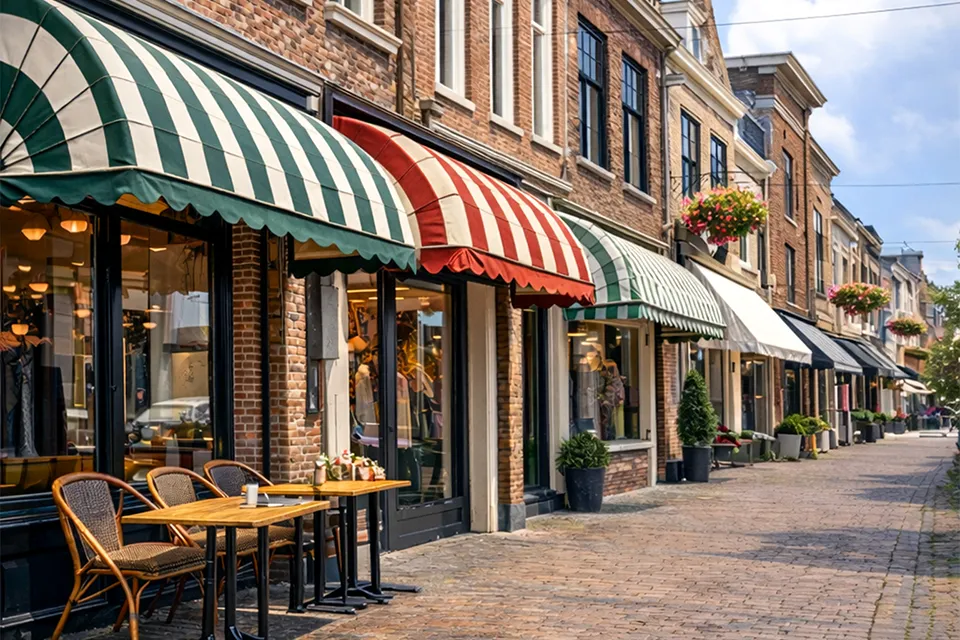
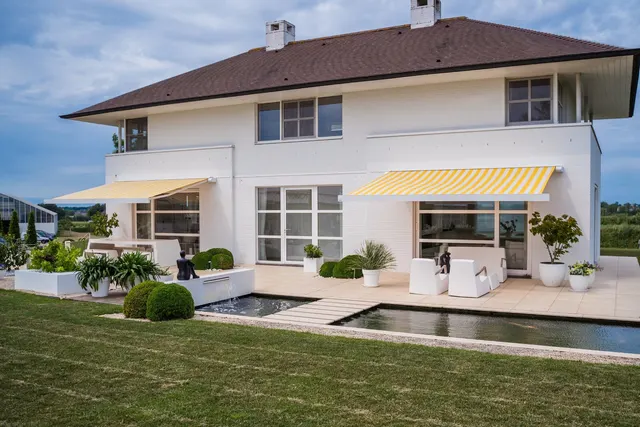
You still see them in shopping streets, on mansions, at restaurants, and increasingly on private facades: awnings. They are sometimes dismissed as ‘nostalgic awnings,’ but if you look at them from a technical point of view, you see a product category in which form, fastening and maintenance play a greater role than with much flatter screen types.
And just because awnings are so visible, discussions about wear and tear, discoloration or ‘why is that cloth suddenly crooked?’ come up more quickly.
What is a marquis anyway?
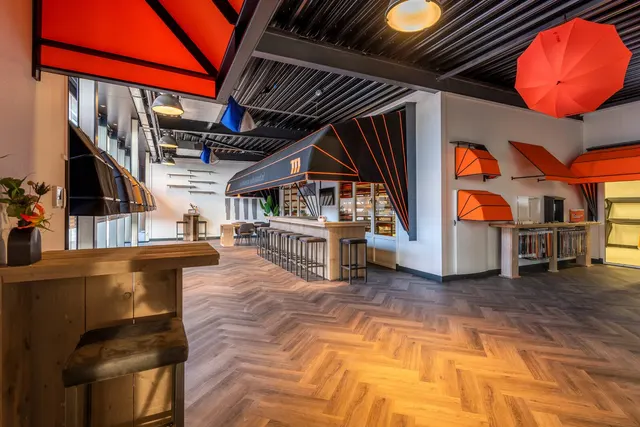
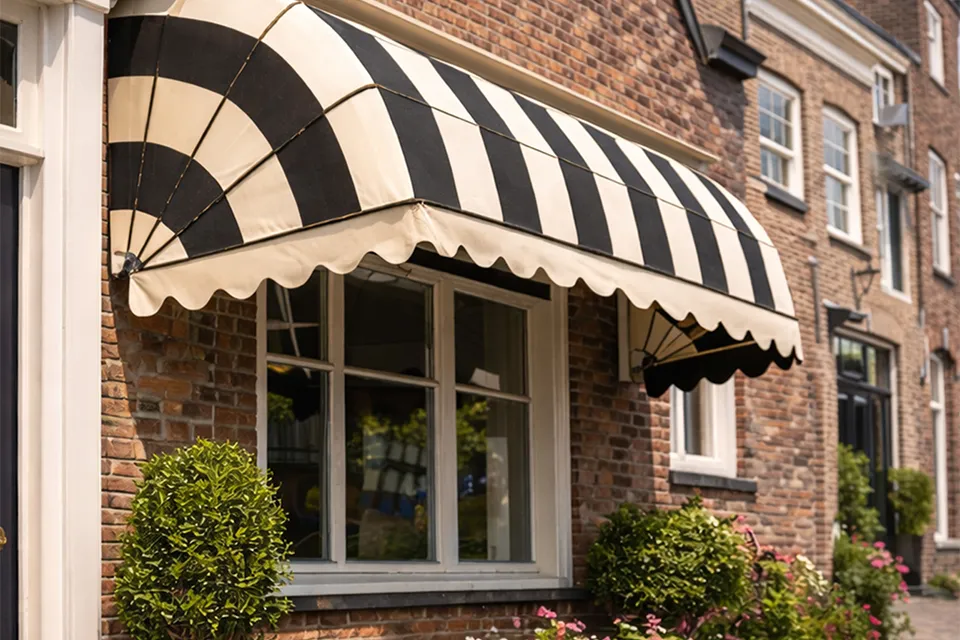
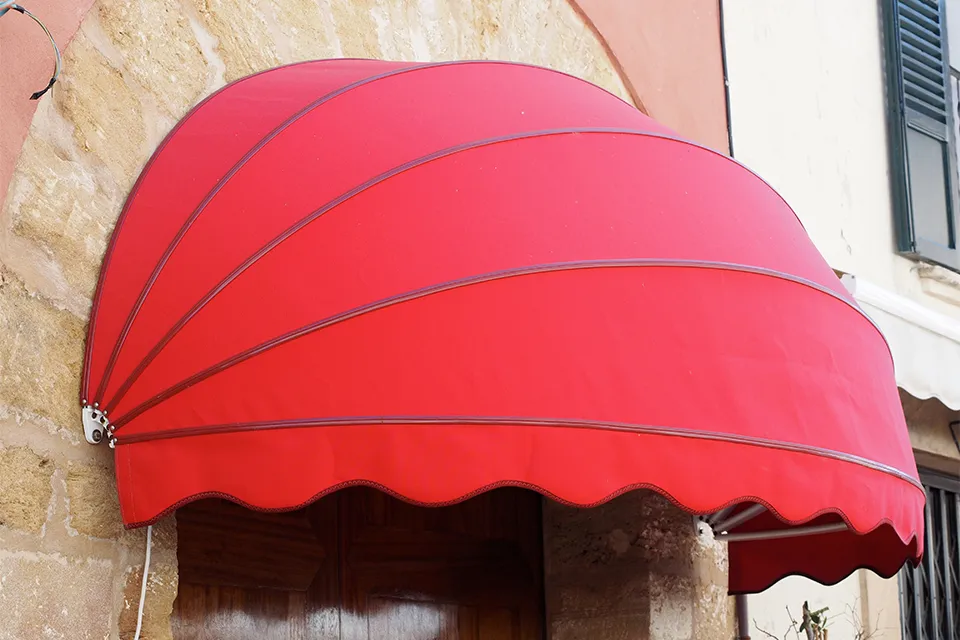
The knowledge base of the National Cultural Heritage Agency (RCE) describes a marquise as a quarter-round awning consisting of a number of portal-shaped frames (wood or metal) to which the fabric is also attached on the side. The RCE also points out that awnings sometimes appear as fixed canopies, but are usually folding and when raised fall within an edge/frame attached to the facade.
That ‘cloth on the side’ is immediately the crux of the matter: an awning is not a flat screen for a window opening, but a shapely hood that allows the awning to ‘flow’ around the window, so to speak. Wikipedia describes this same logic: awnings are effective because not only the front, but also the sides are covered with cloth.
Why that form is not just aesthetics
The RCE mentions a classic problem with awnings: the so-called corner sun that falls in at certain positions diagonally below or along the screen. To limit this, there is the markisolette, among others, with a vertical part and a protruding part at the bottom.
An awning takes a different approach: because the fabric is also attached to the sides (and the canopy has a quarter-round shape), the awning becomes more ‘enclosing’ than a flat screen that is open on the sides. This is not a marketing claim, but a direct result of the construction as established by RCE and other descriptions.
Construction: ‘strokes’, hinges and the hood that protects the canvas
Anyone disassembling or repairing an awning quickly comes across its typical construction: a frame with multiple U-shaped framework (‘battens’) connected via hinges. Wikipedia mentions that the frame can consist of at least four wooden or aluminum U-shaped frames.
Also notable is the detail of protection when raised. The same source states that above an awning a horizontal board and on the sides vertical boards are mounted so that when the screen is raised, the fabric remains dry and protected from dirt. This seems like a small detail, but in practice it is one of the reasons why awnings (if properly maintained) can remain ‘presentable’ in the street scene for a long time: the fabric does not disappear completely unprotected in a cassette, but is given a physical shield via hood and sides.
The RCE also mentions another model detail that you often see in bids: the cap model, in which the last window frame is attached slightly higher to give a higher clearance height.
Standardization and ‘wind class’: where the hard facts are
One thing is important for professional practice: outdoor awnings are not just ‘building decoration,’ but also fall within a European framework of performance requirements. The product standard EN 13561 describes performance requirements for outdoor blinds and awnings, including safety, and also addresses ‘significant hazards’ in assembly, transportation, installation, operation and maintenance, among others.
Wind loads are a key issue in this regard. In 2019, the European Commission published Delegated Regulation (EU) 2019/1188, which establishes classes of performance for resistance to wind loads for ‘external blinds and awnings. The justification states explicitly why: the existing classes from EN 13561 were not sufficient for all products on the market, and their use could in some cases lead to safety issues linked to the fixing (’fixing‘) of products.
Another important point from that regulation: wind classes are defined in wind pressure (N/m²) and a distinction is made between product subfamilies with different tables and class ranges. For example, some product subfamilies are given classes 0-6, others 0-3 and (in the case of articulated awnings/folding arm awnings) 0-2.
The practical implication is clear: whoever says ‘wind class’ should actually also be able to say according to which table/product family and based on which wind pressure values.
CE marking and performance information: why documentation is part of the product
Under Construction Products Regulation (EU) 305/2011, it is about expressing performance of construction products in a harmonized way, and using CE marking in that context. The European Commission practically sums it up: a Declaration of Performance (DoP) is a document that provides information on the performance of a construction product and is necessary to apply CE marking.
This is relevant for awnings for a simple reason: if wind loads and secure fastening are explicitly named as safety factors in the EU framework, then it becomes increasingly important for installers and dealers not only to deliver ‘a beautiful awning,’ but also to have the correct performance information and mounting conditions clear.
Maintenance: the typical ‘marquis problems’ are often already in the manual
Anyone who does a lot of service in the field will recognize the classic complaints: creases that ‘pop out,’ fabric layers that start to rub when retracted, or small holes that suddenly pop up. Interestingly: in most service instructions, this is often described not as a product defect, but as a usage characteristic or consequence of circumstances.
In this way, outward folding becomes inherent in the product. Also, if cloths are soiled in the folds, holes may appear in windy weather - when retracted - due to abrasion. This can be mitigated with regular maintenance.
Concrete - recommended! - routines that are remarkably ‘low tech’ but have impact:
- Remove dirt from pores twice a year (e.g. with vacuum cleaner and brush nozzle);
- Hood and hinges rinse/clean regularly, especially on the coast due to salt deposits;
- For wooden hoods/frames: maintain woodwork like paintwork on the house; pay particular attention to dark colors, which require extra attention;
- Winter storage: several instructions recommend that awnings be stored during winter months (or in windy locations / long periods without use), as this can extend their life;
- And then there is the ‘minor accident’ that often has major consequences: closing an awning wet. Awnings or other awnings are best not turned in wet, because that can lead to mold and stains; so let them dry first.
Question about this story? Ask your question
Keep following this
Get an email when a new story is published. No account needed.
- ThemeSolar shading against heat and energy loss
- SubjectSolar shading & canopies