zenronline.eu
EN

Platform on sun and daylight control, shutters, patio covers and closures
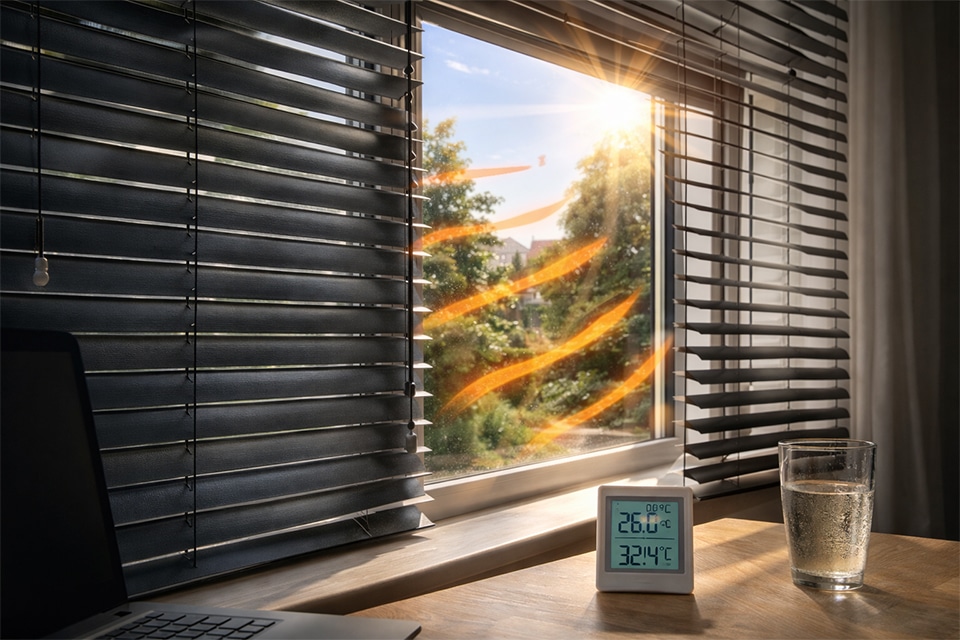
Interior window coverings are almost a given in homes and commercial buildings. Roll-up blinds, venetian blinds, pleated blinds, Roman shades, and slats provide privacy, ambiance, and control over natural light. But as summers get hotter and overheating becomes a greater concern, a more pressing question arises: how effective are interior sun protection systems really at keeping out the heat?
The honest answer is nuanced. Interior sun protection can contribute to comfort, but it is rarely the primary defense against overheating. This has less to do with product quality than with building physics. If you wait to block solar radiation until after it has passed through the glass, you’re too late in the process. By then, a significant portion of the heat has already entered the building.

Sun protection is most effective when it intercepts solar radiation before it reaches the glazing. External sun protection, such as screens, awnings, drop-arm awnings, or roller shutters, keeps a large portion of the sun’s heat out of the building envelope. Interior shading works behind the glass. It can reflect light, reduce glare, and improve the indoor experience, but some of the absorbed heat is still transferred to the interior space.
Milieu Centraal sums this up in practical terms for homes: exterior sunshades are clearly more effective than interior ones at keeping a home cool. Their summer strategy is logically structured: keep the sun out, keep windows and doors closed as much as possible during the day, and ventilate only when it’s cooler outside.
That doesn’t mean that interior sun protection is useless. Where interior sun protection really excels is in visual comfort. In homes, this involves privacy, ambiance, low-angle sunlight, and glare. In offices, schools, healthcare settings, and hospitality projects, screen comfort is an additional consideration. Especially with large glass surfaces, uncontrolled daylight can lead to annoying reflections, eye strain, and spaces that users end up ‘closing off’ themselves with temporary or inefficient solutions.
There is also a logical basis for this. EN 14501 addresses sun protection and shutters in terms of thermal and visual comfort and examines performance characteristics and classification. This approach is important. Interior sun protection is not merely a decorative product. Properties such as light transmission, reflection, absorption, glare control, privacy, and the view to the outside can be technically evaluated.
In practice, overheating is rarely caused by a single factor. Large glass surfaces, limited nighttime ventilation, high levels of insulation, urban heat stress, internal heat loads, and occupant behavior all reinforce one another. That is why the solution is almost always a combination of measures.
Interior sunshades can reduce some of the solar radiation and, above all, lessen the glare from bright light. However, if heat enters through the glass during the day and is not adequately dissipated at night, the indoor temperature will continue to rise. Conversely, ventilation without window treatments is often insufficient when solar radiation is high. The combination of shading, ventilation, architectural shade, and, if necessary, active cooling determines the final result.

For professional applications, this is a crucial point. Anyone who sells or specifies interior sun protection as a ‘solution against heat’ must clearly state the conditions under which it works. In a bedroom with an east-facing wall, a well-chosen blackout or reflective system can provide a great deal of comfort. In a southwest-facing living room with large windows and high solar gain, exterior shading, solar-control glazing, or architectural shading will be much more effective.
Summer comfort has now also become a subject of mathematical analysis. In the Netherlands, NTA 8800 is the standard used to determine the energy performance of buildings. Within that context, TOjuli serves as an indicator of the risk of overheating in new homes.
This development is relevant because it makes the discussion about sun protection less of a casual matter. It is no longer just about subjective complaints regarding comfort, but also about demonstrable performance. Since the rules regarding active cooling were tightened, it is no longer enough to simply ‘check the box’ for cooling as a solution to overheating. It must be demonstrated that the cooling capacity is truly sufficient, or that solar gain is adequately limited through passive measures.
As a result, the professional approach to interior sun protection is shifting from product to system. It’s not just about ‘which fabric looks nice?’, but about the combination of glazing, orientation, sun protection, ventilation, operation, and user behavior. In that context, interior sun protection can indeed be valuable.
A reflective roller shade can reduce annoying glare. A pleated shade with a honeycomb structure can help create a comfortable environment near the window. Venetian blinds allow you to control the amount of daylight without completely darkening the room. Interior screens can maintain a view of the outside while still reducing glare.
Automation can further improve that performance. Manual sunshades are often used too late or inconsistently. Smart controls based on sun position, time, temperature, or light levels prevent sunshades from being closed only after the room has already heated up. Especially in commercial buildings, where user behavior is difficult to predict, this can make the difference between a theoretically good product and an effective solution.

Interior sun protection remains a staple—and rightly so. It is often the fastest and most practical way to reduce glare, enhance privacy, and make daylight usable. But when it comes to preventing overheating, it must be viewed realistically. If you really want to keep heat out, you should ideally start before the glass.
The most effective solution is therefore rarely a single product. It lies in the combination of limiting solar gain, controlling daylight, enabling ventilation, and taking user behavior into account. Interior shading plays a useful role in this, as long as we don’t market it as something it physically cannot be.