zenronline.eu
EN
Platform on sun and daylight control, shutters, patio covers and closures

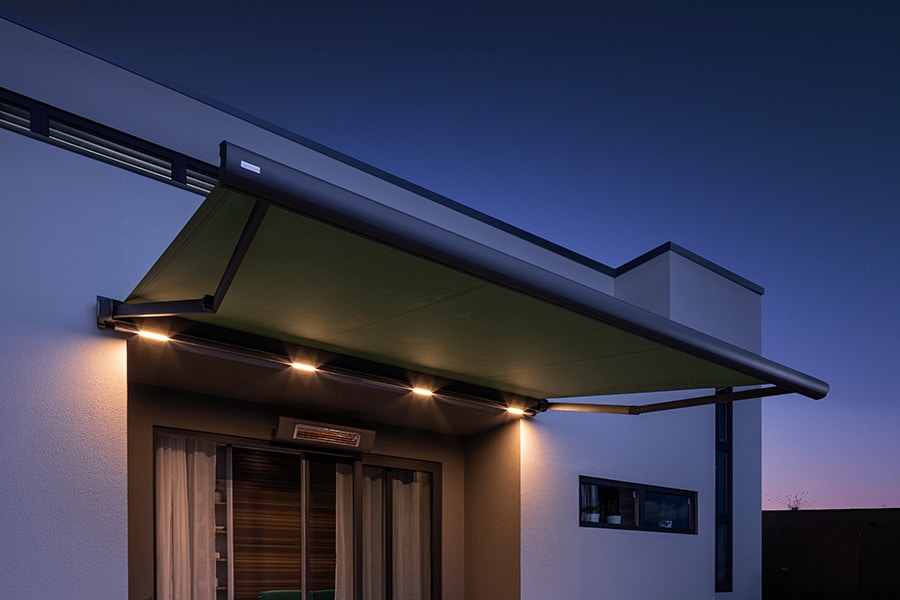
On a sunny day, the image is recognizable: an articulated screen rolls out, the patio becomes shade and the facade remains free of poles or uprights. But behind that seemingly simple comfort is a product category where wind load, fastening and documentation are decisive for safety as well as longevity.
If you want to see through the marketing language, you soon come to the standardization and (European) rules around declarations of performance.
Technically, what sets an articulated awning apart is the mechanism with (articulated) arms that are under tension. Assembly instructions explicitly warn that those arms are ‘under great tension’ and that improper handling can lead to damage and/or injury. Such warnings say something important: with this product, it is not just the fabric that ‘works,’ but primarily the construction and the transfer of forces to the façade.
That transfer of forces brings us to the key point: when problems arise with articulated awnings, it's often not because the concept isn't sound, but because load, use and mounting don't match what the product (and substrate) can handle.
For external awnings such as articulated blinds, EN 13561 is the relevant product standard. The Dutch standards body NEN describes EN 13561 as a standard that establishes performance requirements (including safety) for outdoor awnings mounted externally to buildings, and also explicitly addresses hazards during assembly, transport, installation, operation and maintenance.
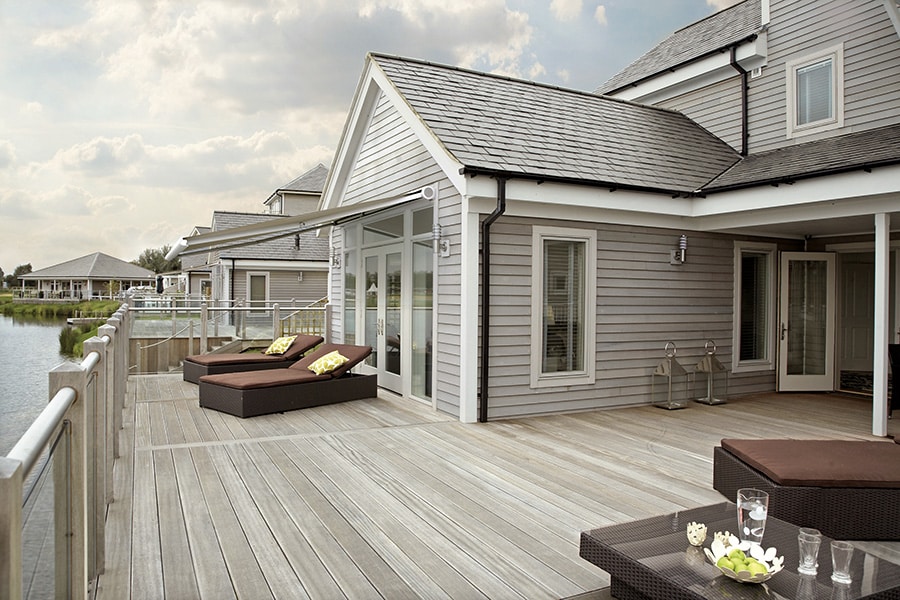
Important detail: so the standard is not just about ‘how long will the fabric last?’ but about safety throughout the entire chain - including the phase when an installer anchors the screen to a facade.
An industry source such as VMRG (facade industry association) emphasizes in its explanation of product standards that within this framework, wind resistance is an important criterion, and products are divided into categories corresponding to a defined wind pressure.
In practice, people often talk about ‘wind class 0-3‘ (sometimes this is even linked to Beaufort levels). But if you look at it strictly legally and normatively, you will see that the EU has tightened the classification around wind loads.
The European Commission published Delegated Regulation (EU) 2019/1188, which establishes classes of performance for resistance to wind load in outdoor awnings and canopies. The recitals state why: the existing classes in EN 13561 were not sufficient for all products on the market and could in some cases even lead to safety problems linked to fastening.
Crucially for articulated awnings, the annex to that regulation uses separate tables by product family. For folding arm awnings (the category that includes articulated awnings), classes 0-2 are defined with corresponding nominal and safety wind pressures (in N/m²).
Actually, whoever says ‘wind class’ should also be able to say: what classification and what wind pressure?
And: if a supplier speaks in terms of ‘class 3,’ it is wise to check which source or table is used for that and what exactly is in the product documentation. After all, the EU regulation explicitly distinguishes between product types.
In addition, there is another element that is often underestimated in practice: class 0. VMRG clearly summarizes this principle (for standardization on awnings/roller shutters): class 0 corresponds to a performance that is not required or not measured, or a product that does not comply with class 1. In other words: ‘class 0’ is not a reassurance, but rather a signal that as a professional you have to be extra critical of what has (or has not) been demonstrated.
Paper is patient; facades are not. Manufacturers' installation instructions repeatedly point out the impact of the substrate and fasteners: installation by a professional, appropriate fasteners, and a substrate with sufficient load-bearing capacity to withstand the forces occurring.
EN 13561 underlines the same thing: even if the product is suitable for a certain wind load, the whole can still fail to meet the standard if wall type, plugs/bolts, supports or placement method are insufficient. This is exactly what the EU regulation also hints at when it warns of safety issues that may be linked to fixing.
The conclusion is therefore sober: the debate about quality is not only about cloth or design, but also about proven performance and correct anchoring.
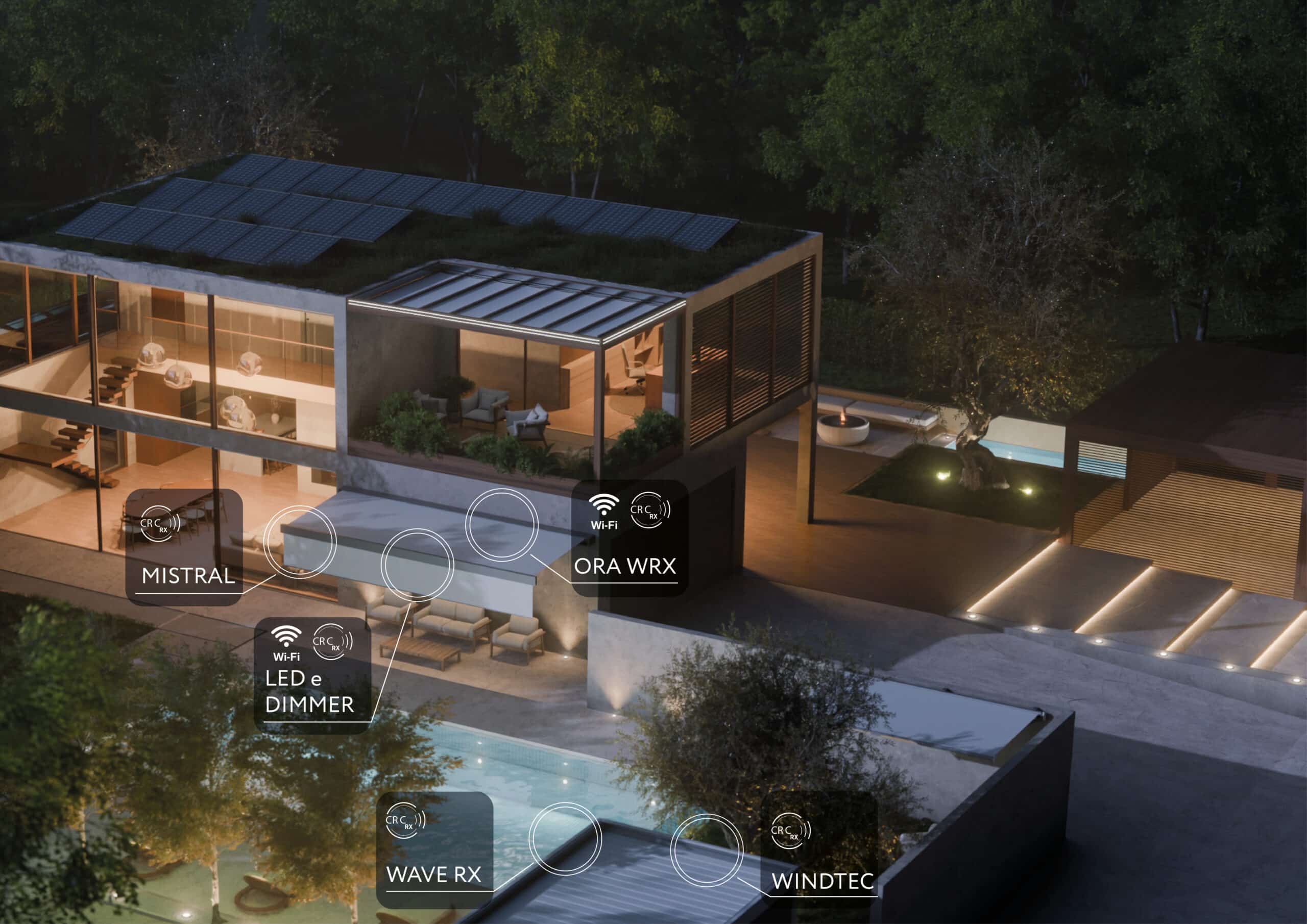
Wind and weather sensors, automation and remote control are often presented as solutions to usage risks. But even there, expectations are better tempered: most of the time, an automaton is a tool and ‘no guarantee’ that the screen will be retracted in a timely manner in case of bad weather; the end user remains responsible for correct use.
For professionals, this is relevant in two directions: as part of correct delivery and instruction, and as realistic positioning: automation reduces risk, but does not eliminate it.
Articulated awnings provide shade and comfort. Yet ‘shade’ is not synonymous with ‘100% protection. The WHO warns that shade structures (such as awnings/canopies) do not provide complete uv protection and that you can also get uv radiation through scattering and reflection. KNMI also explains that uv can come ’from all directions‘ and that you can get sunburn even in the shade, although more slowly. This is not a detail, but useful context for those who want to inform customers correctly: an articulated sunshade is excellent for comfort and direct irradiation, but not meant to be ’all-in-one‘ sun safety.
Anyone comparing or recommending articulated awnings can work more neutrally and objectively by making at least these documents/questions standard:
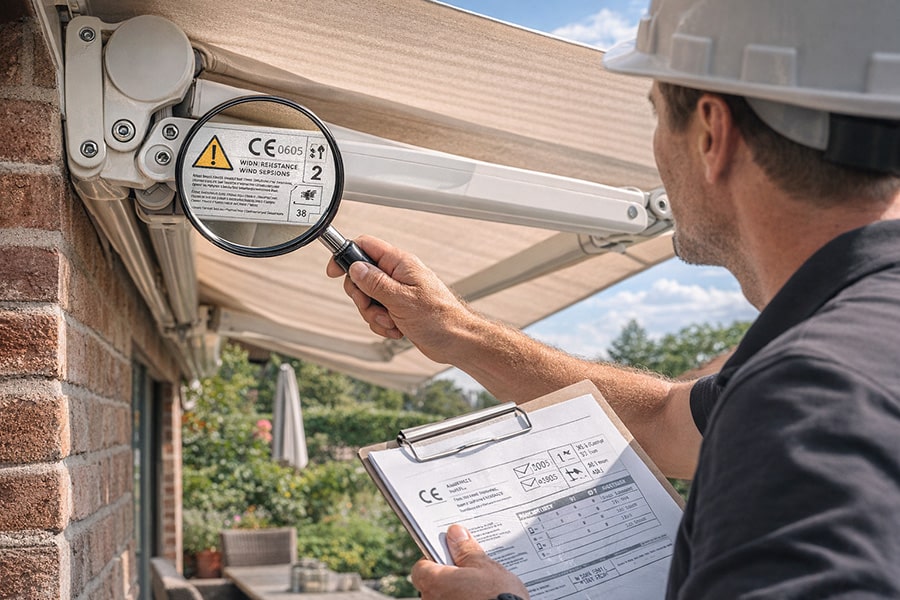
- CE marking and performance information: under Construction Products Regulation (EU) 305/2011, CE marking is related to expressing performance of construction products.
- Which wind class/wind pressure is declared (and according to which table/classification)?
- Mounting conditions: what substrate, what mounting system, what boundary conditions? (manuals make it clear that incorrect mounting can lead to damage/injury).
- Instructions for use: explicit warnings around wind, articulated arms under tension, and the fact that it is not a rain screen.
In short, the greatest gain is often not in yet another superlative (‘stormproof,’ ‘windproof’), but in transparency: demonstrable performance, correct assembly and clear communication about limits of use.