zenronline.eu
EN

Platform on sun and daylight control, shutters, patio covers and closures

At the VELUX Daylight Symposium and Healthy Buildings Day in Paris this week, the VELUX Group is bringing together more than 600 international professionals for two knowledge days full of new insights on the importance of daylight and fresh air. The focus is on bridging theory and practice: how do we design, build and create healthy buildings and living environments?
Scientists, architects, developers, urban planners, building owners, policymakers and building professionals from North America, China and Europe will share their latest research and vision and engage in conversation in Paris. The VELUX Daylight Symposium on Oct. 9 will discuss the crucial role of daylight in designing and creating healthy buildings. The Healthy Buildings Day looks at the effect of indoor climate on people's health. How do we create healthy workplaces, homes and schools? From the Netherlands, speakers include Ronald Schleurholts (architect, owner CEPEZED), Mariëlle Aarts (Assistant Professor TU Eindhoven) and Harwil de Jonge (director Heijmans Vastgoed), in addition to internationally renowned speakers such as Joseph Allen (Harvard School of Health), Till Roenneberg (Ludwig Maximilian University of Munich) and Hiroshi Sambuichi (Sambuichi Architects).
Ronald Schleurholts, architect and owner at CEPEZED is one of the speakers at the VELUX Daylight Symposium. For him, daylight is essential in today's way of building: "When artificial light did not exist, buildings were naturally designed for natural light. Starting in the 1960s, more and more artificial light and air treatment came into buildings, so the importance of natural light and natural ventilation faded into the background, resulting in many 'sick buildings'. Recently, under the influence of private certifications, the desire for sustainability and healthy working environments, there has been a renewed focus on the quality of light and air in the built environment. Still, there are many building types where the minimum requirements of daylighting are barely met. Even under the influence of current energetic building requirements, such as BENG, the focus is on super-insulated and closed buildings. Humans depend on natural influences and have a built-in need for the intensity, variety and broad spectrum of daylight. Here lies a great task for designers and clients!"
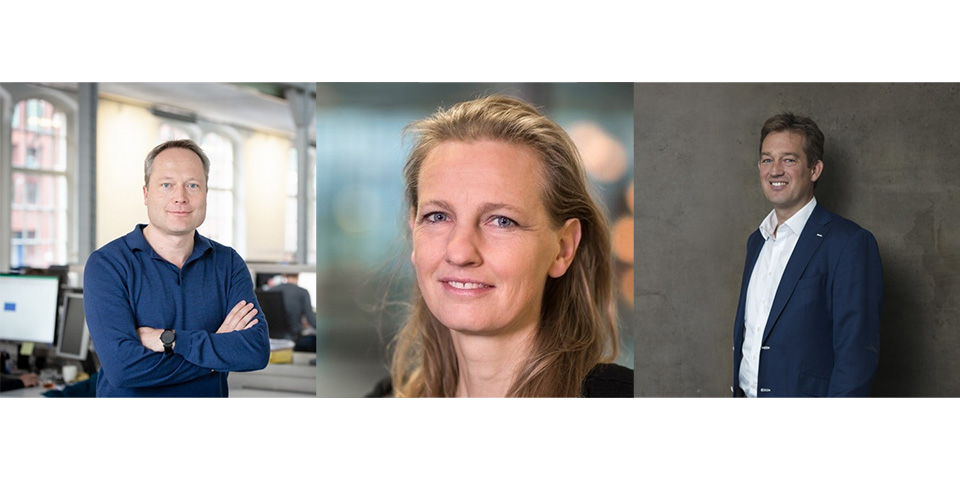
From left to right: Ronald Schleurholts, Marielle Aarts and Harwil de Jonge
Mariëlle Aarts, Assistant Professor at TU Eindhoven and a specialist in light in the built environment, will also speak on this day. She investigates the effects of daylight on the users of a building: "If you ask people what is better for their health, daylight or artificial light, many will say daylight. We study what makes daylight so important for health. It is important to find out concretely what that is, because in this way it can be demonstrated that daylight has a positive influence on people. This is necessary to prevent, for example, choices being made in construction that negatively affect the indoor climate. Users spend 90% of their time indoors. How do we ensure that indoor space supports people in their functioning and also keeps them healthier? Focus on the effect of daylight on stress, sleep and work performance in hospitals and office environments in particular. It's important to continue to bring attention to the value of daylight."
Harwil de Jonge, director at Heijmans Vastgoed, speaks at Healthy Buildings Day on October 10. He places a healthy building in a broader context: "At Heijmans, we look at four ingredients in creating a healthy living environment on the basis of sustainability: energy, materials, space and the social aspect. With energy you look at the generation, use and storage of energy in a building. Materials is about what you use, such as circular materials. Space includes biodiversity, climate adaptation and mobility. How do you stimulate walking, running, hiking and cycling in an area? With climate adaptation and biodiversity, you have to think about applying the right greenery in an area. How does that counteract the impact of today's huge rainstorms and global warming? The social theme is about people, how do they experience and use an area? Simply put, the choice between an unhealthy building in a healthy environment or a healthy building in an unhealthy environment is impossible. Health is about more than a building, it's about the total living environment."
For the first time, the VELUX Group's two symposia, the VELUX Daylight Symposium and Healthy Buildings Day, are being organized consecutively. With this, we aim to bring scientists, architects, developers, urban planners, building owners, policy makers and building professionals closer together and create stronger synergies across the building value chain. During these two days, knowledge will be exchanged and practical examples will be shared so that we can accelerate practice and make buildings healthier.
The VELUX Daylight Symposium, held every two years since 2005, is an internationally recognized event that focuses on daylighting research, education, practice and policy making. The 8th Daylight Symposium maintains its broad architectural agenda related to daylight while sharing new cutting-edge research within a like-minded community. The program features a mix of invited speakers and selected submitted papers related to daylighting, building performance and human health, as well as architectural case studies
Healthy Buildings Day, held every year since its first edition in 2015, brings together key players in the building industry for a dialogue on value, design and user trends. There is a strong focus on how daylight and comfort in buildings can be made tangible by showcasing case studies, results and user experiences. By showing smart solutions such as the combination of VELUX skylights with VELUX ACTIVE, the VELUX Group shows how it continues to innovate to further improve the health of buildings.