zenronline.eu
EN

Platform on sun and daylight control, shutters, patio covers and closures

Glass walls are a remarkably successful product category. They fit today's demand for light, sightlines and ‘indoor-outdoor’ living. In homes, you see them as large sliding doors or conservatory/verandawalls; in utilities as transparent partitions; and in outdoor living as (sliding) walls under a canopy that break wind and rain without taking away the view.
But precisely because glass ‘does’ so much in a building - letting light through, letting heat in, muffling or amplifying sound, and influencing safety - it only really becomes interesting once you look at the details. The question then is not: ‘Do I want glass?’ but: what glass wall is this exactly: a windbreak, a facade, or a new climate shield?
In practice, three functions often intertwine:
Visual separation (inside): glass as a transparent wall with no intention of keeping heat out;
- Facade and thermal envelope (exterior): glass as part of a heated/cooled envelope, with requirements around insulation, drafts, and summer comfort;
- Buffer zone (sunroom/veranda/outdoor living): glass seals off from wind and rain, but the space is not always meant to be a ‘full-fledged’ heated room.
The latter point is often underestimated. Milieu Centraal, for example, explicitly states that in an unheated conservatory that consists largely of glass, can be closed off from the house and faces the sun, it can be better to use single-glazing ‘because of the large glass surface’ because the temperature would otherwise become too high in summer - while HR++ is recommended between the house and the conservatory. This is a remarkably sober point of view: glass choice is not only insulation optimization, but also summer comfort strategy.
Anyone who installs glass walls sooner or later gets the same question from occupants, architects or building physicists: how do we keep it cool? Large areas of glass provide daylight and winter gains, but also increase the risk of overheating.
In the Netherlands, this is not only a comfort discussion, but also an arithmetic one. RVO explains that the TOjuli indication follows automatically from attested software in the BENG/NTA 8800 calculation, and links the limit value (TOjuli 1.20 per orientation) to the GTO background.
Nieman additionally describes why this makes the glass wall discussion tougher since the tightening as of July 1, 2024: active cooling ‘ticking’ is no longer automatically enough; there must be a plausible case that the cooling capacity is sufficient, or you have to show that sunlight penetration is sufficiently limited by passive measures such as shading, solar control glass or shade (overhang/balcony). Their explanation even includes a practical design logic: if more than 95% of the glass area adequately blocks solar radiation, then (with active cooling) limited overheating risk is assumed; even a relatively small glass area relative to use area can be a route.
Glass walls sit at the intersection of aesthetics and risk. A glass wall that is accessible to users, stands in a walkway, or shields a fall hazard requires safety glazing. There is a prescriptive story behind that.
- The required classification of the fracture pattern according to NEN-EN 12600;
- that the composition of inclined glazing, non-four-sided glazing and fall-through glazing should be determined based on NEN 2608 and/or NEN-EN 1990 and 1991 (Eurocode structure and loads).
That reference is important because it makes it immediately clear: glass walls are not only about glass thickness, but also about bearing, fastening and loads.
So what exactly do they test and classify? NEN describes that EN 12600 specifies a pendulum test (pendulum test) to classify flat glass for performance under impact and breakage mode. And for thermally toughened safety glass, NEN mentions that EN 12150-1 specifies (among other things) tolerances, flatness, edge finish, fragmentation and physical-mechanical properties for monolithic thermally toughened soda lime-soda safety glass in buildings.
For laminated (safety) glass, there are additionally definitions and component descriptions in the ISO 12543 series; NEN explains that NEN-EN-ISO 12543-1 defines terms and describes components for laminated glass and laminated safety glass in buildings.
Anyone who places glass walls in a building context notices that ‘paper’ has become part of the product: performance statements, standards references, product choices.
Rijksoverheid summarizes the principle of the ‘Besluit bouwwerken leefomgeving’ (Bbl): a structure may not pose a danger; therefore, the government lays down rules for safety, health, usability and durability, and a structure must comply with those rules. The same page also mentions that in complying with Bbl rules you use tools such as NEN standards, and refers to CE marking in that context.
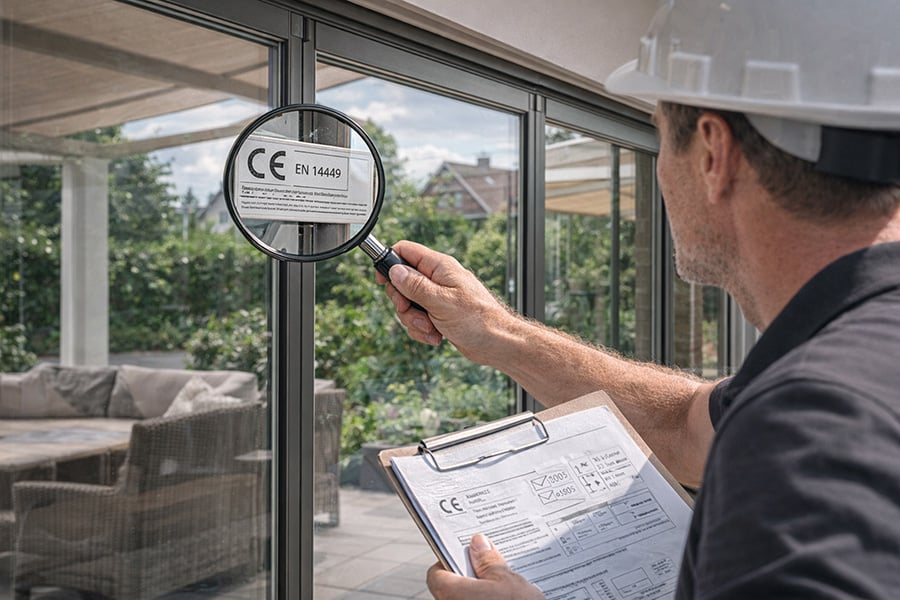
For laminated glass, moreover, CE marking is explicitly linked to standards frameworks. Kiwa states that with CE marking, the manufacturer declares that properties have been determined on the basis of EN 14449, and that CE marking has been a legal obligation for manufacturers of laminated glass and laminated safety glass since 2007.
Especially with terrace or veranda walls, the question quickly arises: is this allowed? One rule is useful here: don't start from the product name, but from its qualification as a (technical) construction activity.
The Living Environment Information Point (IPLO) explains that the general state regulations of the Bbl state when the technical building activity is subject to permit or notification, and provides criteria for structures with and without a roof (e.g., height, underground, change of support structure/fire compartmentation, etc.).
For a glass wall under an existing canopy, the outcome may depend heavily on context (height, construction change, monument status, environmental plan, fire safety, and so on). Check via Bbl/IPLO and then locally.
A glass wall that appears ‘simple’ in design often becomes complex in execution. A useful sequence:
- Determine the function of the space: heated envelope or buffer zone? This drives glass selection and comfort expectations;
- Make summer comfort explicit with large areas of glass: shading/solar glass/shading not as an upgrade, but as a prerequisite;
- Define safety goal: injury safe, fall through safe, impact risk? Use standards as a framework, not as an after-the-fact appendix;
- Check construction & bearing: non-four-sided bearing, height, wind load and fastening are part of the design, not just assembly;
- Documentation/statements: ensure that standard references and CE/DoP-like product information are traceable towards the client and regulator.
In short, glass walls have long since ceased to be a ‘neutral building material’: they control comfort, safety and regulation at the same time. In the current Dutch playing field - with its emphasis on summer comfort and demonstrability - the quality of a glass wall is increasingly determined by what you don't immediately see: the solar strategy, the choices of standards, the loads and the documentation. And that is precisely where the difference lies between a transparent solution that works for years and a transparent problem that you have to explain over and over again every summer.