zenronline.eu
EN

Platform on sun and daylight control, shutters, patio covers and closures

Nearly zero energy buildings (BENG) are not hype, but from 2021 simply the norm. Indeed, the current EPB requirements (Energy Performance and Indoor Climate - saving energy and CO2-emissions reduction) will become more stringent and merge into the new BENG rules. These developments also concern the blinds industry, and so fabric manufacturer Serge Ferrari is also involved.
Energy-neutral buildings are characterized by their E levels below 30. These values are achieved through the best possible thermal insulation, low net energy requirements for heating, ventilation and the use of renewable energy. “An important additional factor that is often overlooked is protection against overheating,” observes Specification Manager Vanessa Visconti of Serge Ferrari. “Shading then turns out to be a very
important factor!”
About BENG
BENG is the abbreviation for nearly energy-neutral building and will become the common energy performance standard for new construction in 2020 (the Netherlands) and 2021 (Belgium, and by extension all of Europe). Depending on the type of building, a BEN building uses almost no energy for heating, ventilation, cooling and hot water. The E-level for a BEN home is below E30. For a school or office, it must be lower than E40 in Belgium.
From Jan. 1, 2020, the energy performance of new buildings in the Netherlands will be determined by three requirements: the maximum energy requirement in kWh per square meter of usable area per year, the maximum primary fossil energy consumption and the minimum share of renewable energy in percent.
In the run-up to the full integration and application of the new rules of the game, they are already being phased in. That trajectory began as early as 2015 and had its most recent update on Feb. 2 of this year with the opening up of the draft requirements for a market response and their inclusion in the building regulations.
It is important to note that the BENG requirements may still change, for example, due to market reaction. Indeed, the requirements that are currently included in building regulations also differ from the original requirements as set in 2015. This may be because practice has shown that certain requirements are a barrier to the construction of certain building types, such as detached houses and high-rise buildings in inner-city areas.
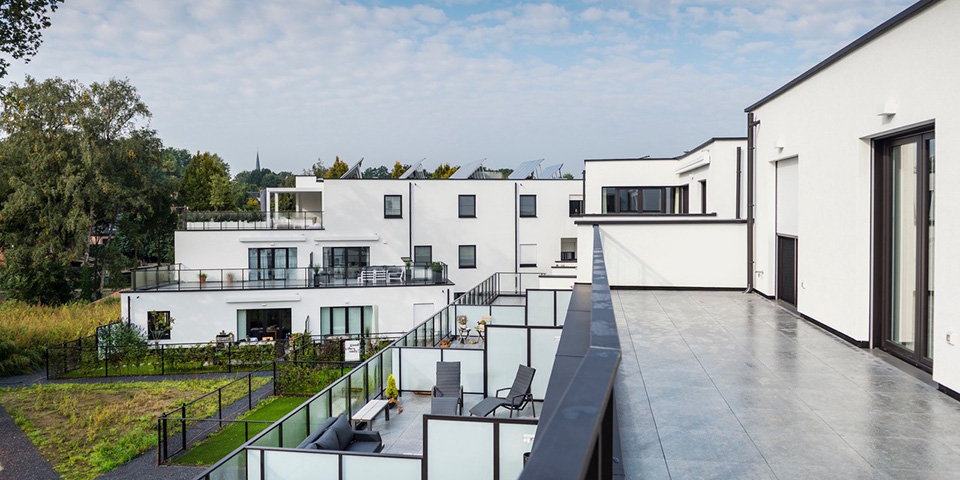
The Gardens of Herentals. (Image: Lando)
The difference from a passive house
Although both a BEN building and a passive house are designed to be as environmentally friendly as possible, there are some important differences. Europe states that a BEN building meets strict energy performance requirements. To achieve them, various insulation and ventilation rules must be followed. The result is a building that comes close to a passive house, but not quite. For a true passive house, more and stricter standards must be achieved.
BENG standards and calculations - including insulation - are based on the current climate outlook. However, global warming can throw a spanner in the works. Partly for this reason, it is important to plan with the future in the back of your mind.
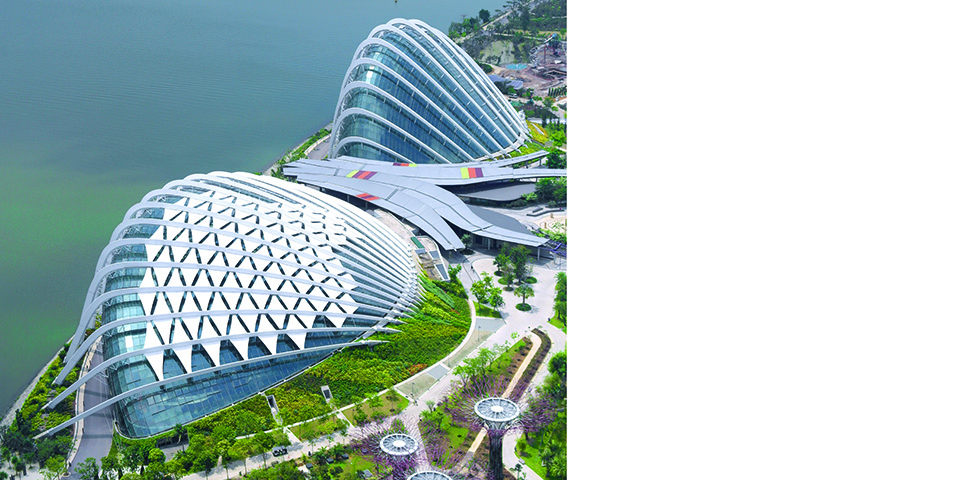
Gardens by the Bay, Singapore. (Image: Serge Ferrari)
Another difference from before is that BENG regulation makes the trade-off of measures more difficult. For example, using extra insulation to compensate for excessive primary fossil energy consumption has become virtually impossible. So from the beginning, all factors must be closely monitored.
Insulation value solar shading
Solar shading is valued within the BENG rules as part of a climate control system. After all, under current climatic conditions, cooling capabilities also play an important role. Because of all kinds of developments - innovations in insulation, climate development - a building is increasingly becoming a puzzle, all the pieces of which must be matched to each other in order to keep the climate control system under the best possible control. Shading appears to be an important piece in that puzzle.
Serge Ferrari and BENG
As already indicated, the BENG regulation covers energy demand, primary energy consumption and renewable energy share.
Serge Ferrari is a supplier of high-quality screen fabrics, and the company's products fall within the first category.
A well-developed energy plan for a near-zero energy building takes into account from the beginning the impact of external factors on conditions inside the building. This, of course, certainly includes solar irradiation, which heats up a building and increases the cooling load. Shading can prevent this. After all, it not only darkens a room, but also keeps excess heat out. “Thanks to the capabilities of Serge Ferrari screen fabrics, it becomes easier to regulate the temperature in a building,” observes Vanessa Visconti of Serge Ferrari. “Our high-quality screen cloths keep out excess heat and are also wind-resistant, incidentally another factor that is not always taken into account.”
Serge Ferrari casts itself as a key partner willing to think along from the design phase of a building or home. The company enjoys working (co)-engineered innovative projects that can already meet the requirements of the stricter BENG regulations today.
This is not just about energy consumption, by the way. Nearly zero energy building - and also the contribution of Serge Ferrari's products to it - is also about the quality of life and comfort of a building's occupants or users. “A nearly energy-neutral building is not ‘either-or,’ but ‘and-and,’” concludes Vanessa Visconti.
Views matter!
Studies show that 68% of people consider the view to be very important with a blinds. A blinds should block blinding light and heat, but still provide a sufficient view of what is going on outside the building. Understandable, since no one likes to live or work in an enclosed space.
Rapid evolution
The energy performance of buildings has evolved faster and more radically between 2010 and 2020 than ever before. In addition, regulations and requirements are becoming increasingly complex, making specialist support more important.
Comfort vs. energy optimization
The top priority of space users - in both residential and work environments - is always comfort. Factors such as glare, transmitted heat and drafts play into the perception of blinds and the comfort experienced by the user. Studies show that past experiences and even cultural background play a role in shaping that perception. Important to consider when planning a building.
Reverse problem
Uninsulated buildings lose up to 30% of their heat through the windows. However, with all the advances in insulation, the opposite effect is slowly emerging: buildings are so well insulated that they continue to heat up, in part due to sunlight entering. Not heat loss, but overheating becomes the main problem! Several case studies by Serge Ferrari show that indoor shading can be an excellent solution for this. Compared to rooms without, the difference can be as much as 19.5°C!
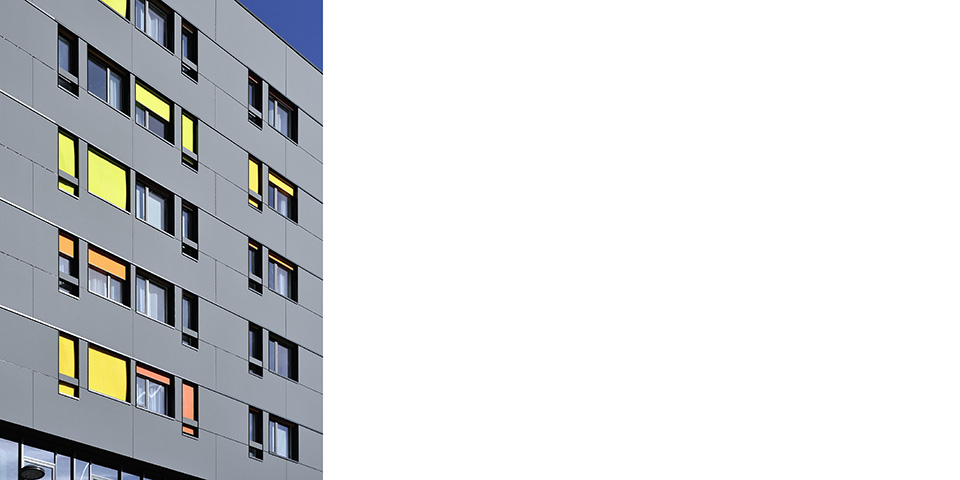
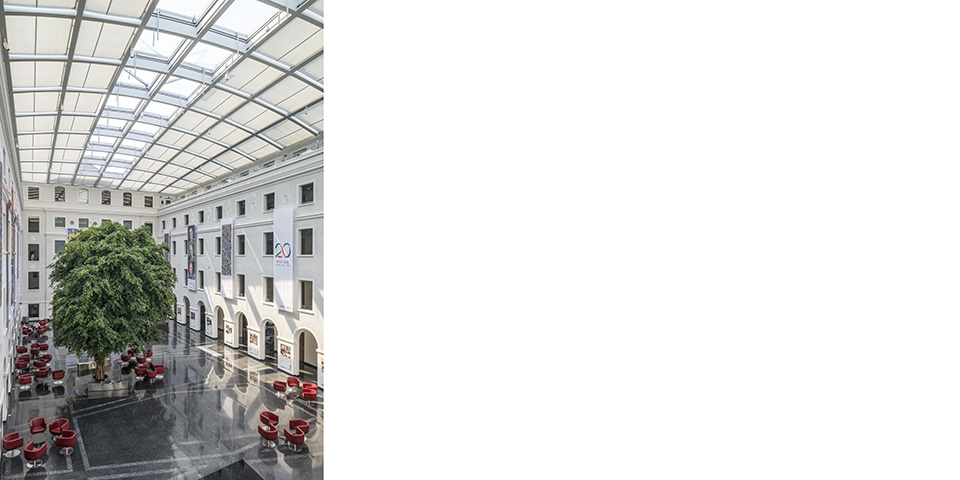
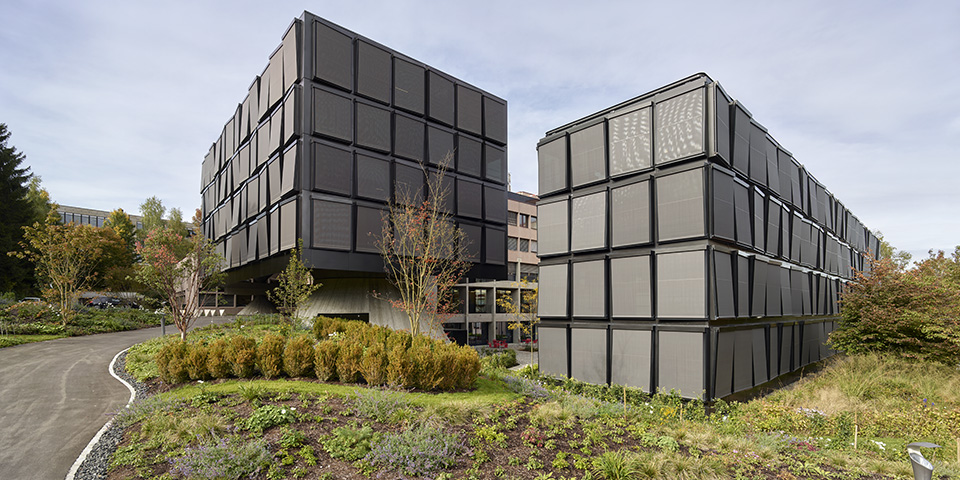
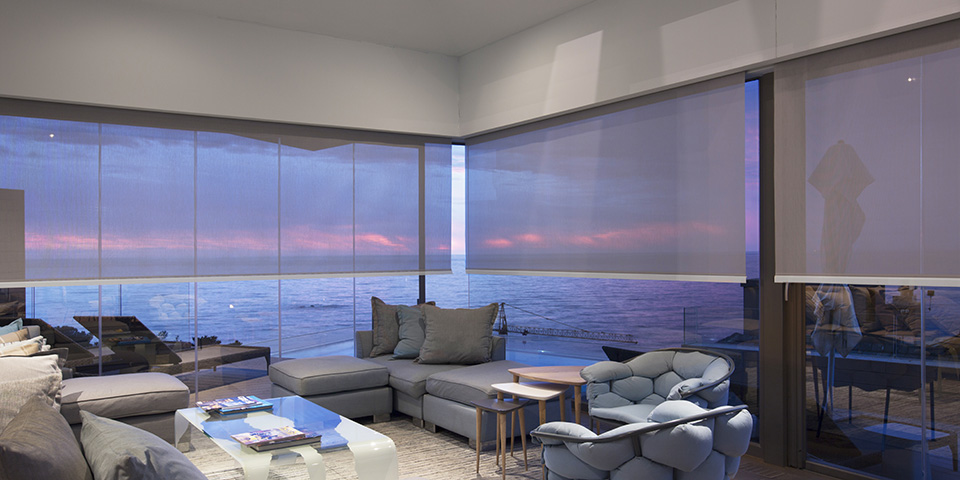
(Images: Pierre Le Chatelier, Studio Odile Decq, Johannes Marburg, Cédric Widmer, Wianelle Photography).
When an architect designs, Serge Ferrari is eager to support him or her in doing so. Catherine Siepiora, Specification Manager Europe, and Jean-Philippe Magot, Vice-President Building Business Group, offer some tips in advance.
“An architect today has to take into account different rules and requirements, such as energy performance,” Catherine Siepiora begins her story. “We are happy to assist them in finding the best solution. Each project has its own challenges and consequently requires a specific approach. We naturally know our products inside out and can therefore always offer a customized solution.”
Cooperation between architect and Serge Ferrari should preferably take place as early as possible. “We can best advise when we get all the information, for example on energy requirements and the type of glazing” continues Catherine Siepiora. “The more information we have, the more specific we can advise.”
Philippe Magot agrees. “There are many different factors to consider when designing a space where blinds are to be applied. Exterior blinds provide optimal thermal comfort, while interior blinds can be used to address visual comfort and mitigate a cold bridge. Not only are the materials different, they serve very different purposes.”
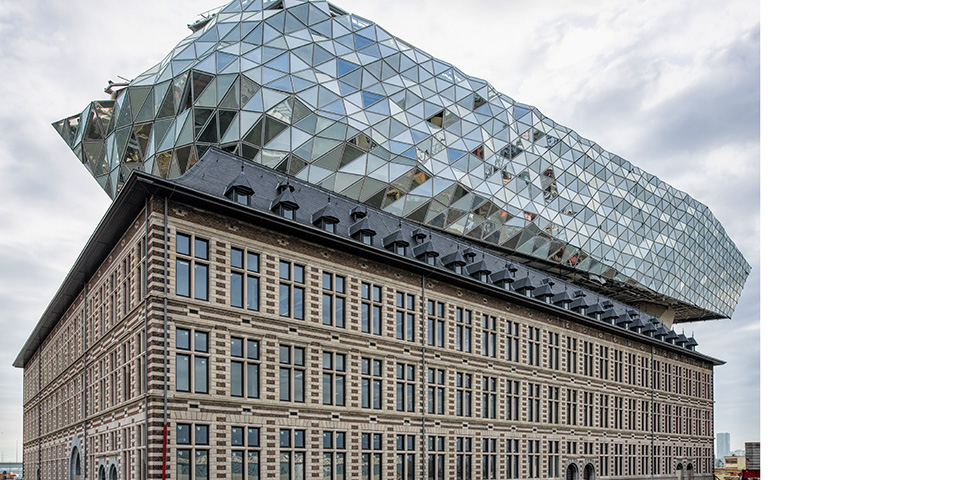
Antwerp Port House (Image: Eric Borghs)
“To comply with - among other things - thermal regulation, an architect must try to gather all possible information,” Magot continues. “You do that by talking to your partners. They can give advice on the best materials, the ideal placement, for example, inside or outside, and so on.” After which Catherine Siepiora concludes, “The best tip we can give is to talk to a reliable partner from the beginning. That's how you get the best result!”
This article is based on the white paper A Good Climate Starts at the Beginning: Serge Ferrari and Near Energy-Neutral Buildings (BENG), by Serge Ferrari released in Spring 2019.